
Best Smart Sauna Controller – What to Look For and Which to Buy
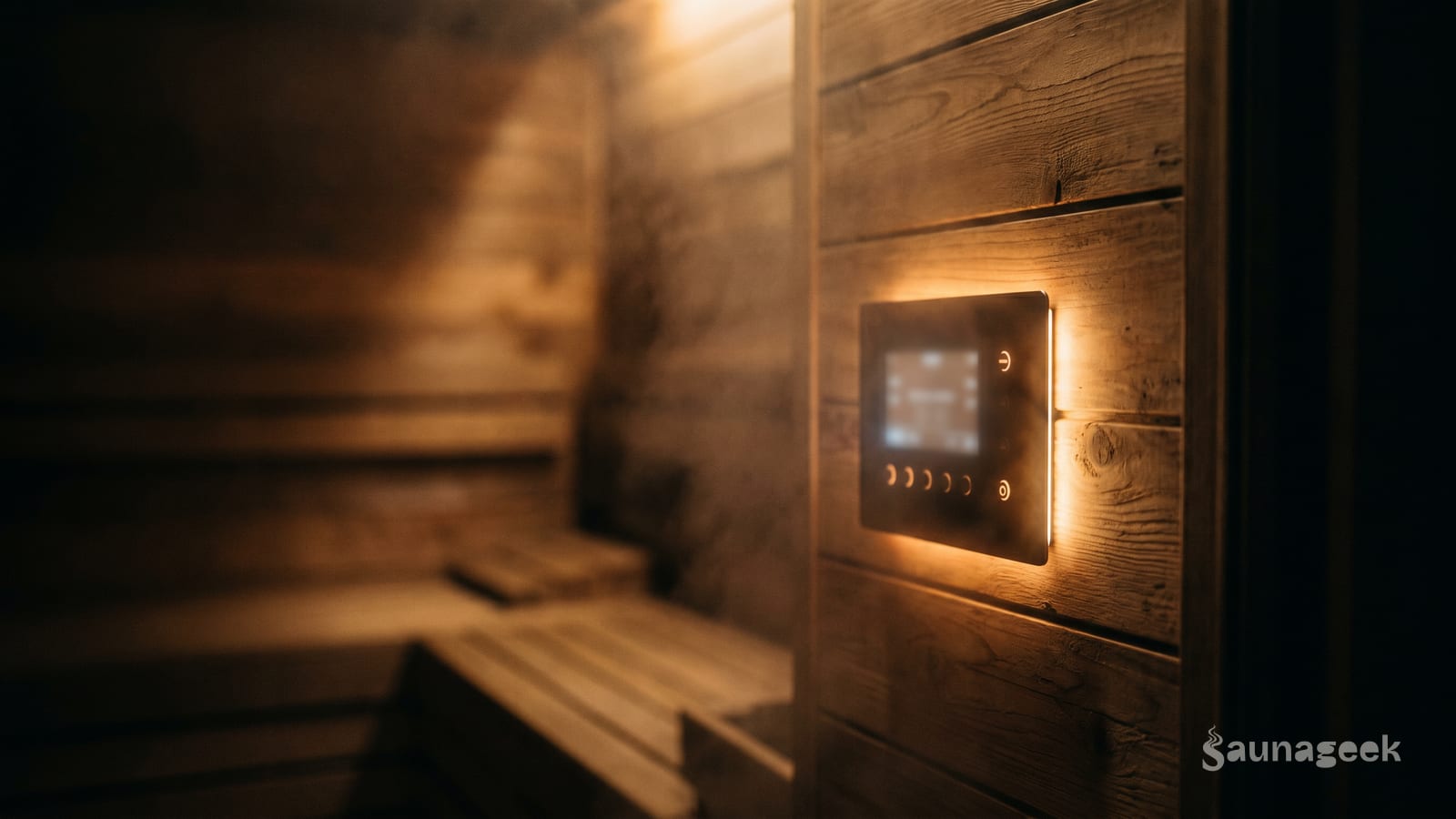
The best smart sauna controller gives you app control, scheduling, and remote preheating on any compatible electric sauna heater. If you still flip your sauna on manually and wait 40 minutes, this is the upgrade that changes everything. Here is what matters, what to avoid, and which controllers actually earn your money.
What Is a Smart Sauna Controller?
A standard electric sauna heater has basic built-in controls: a dial, a timer, maybe a simple on/off switch. A smart controller replaces that experience with app-based management and automated scheduling.
The system has three parts. The control panel sits outside the sauna room, usually on the wall near the door. The power unit lives near or inside the heater. The temperature sensor runs from the power unit into the sauna room, typically through the ceiling, to measure the actual heat inside.
A smart controller adds one thing above all else: connectivity. Whether that is Wi-Fi, 4G, or local-only depends on the model, but the result is the same. You can start heating your sauna from the couch, set a schedule so it is ready when you wake up, and monitor temperature without getting off the couch.
One important distinction that trips up a lot of buyers. A smart controller is not the same as a smart heater. Some heaters, like the HUUM Drop or Finnmark Plate, have built-in smart controls. A standalone controller adds smart functionality to an existing heater that does not have it. If you already own a compatible electric heater, a controller is the more flexible option. If you are buying new, compare the total cost of a non-smart heater plus controller against a smart heater before deciding.
Why Go Smart? The Real Benefits
Remote preheating is the killer feature. Most people run their home sauna on a schedule, but a fixed schedule does not match a flexible life. With a smart controller, you start heating from your phone while you are still finishing dinner. The sauna is ready when you are, not the other way around.
Scheduling lets you align heating with off-peak electricity tariffs in markets where that matters. You can set the sauna to heat automatically at 6am on Saturday morning, well before you have even opened your eyes.
Beyond that, you get usage data, multiple user profiles, and integration with lighting or ventilation systems depending on the model. Some controllers track energy consumption, which is genuinely useful if you are watching your power bill.
The practical upside is simple. A smart controller turns your sauna from something you have to plan around into something that fits into your day like the kettle does.
Key Features to Look For
Before looking at specific products, here is what actually matters when comparing smart sauna controllers.
Temperature range. Most controllers support 40 to 110 degrees Celsius. That covers standard Finnish sauna temps. Check that the range matches what you want.
Scheduling and timers. All smart controllers offer basic scheduling, but the flexibility varies. Look for multiple daily schedules, week-day separation, and override options.
Connectivity type. This is where the real trade-offs live. Wi-Fi controllers need a reliable signal near your sauna. If your sauna is in a detached building or a basement with poor coverage, a Wi-Fi controller will frustrate you. 4G controllers work anywhere with cellular signal but carry an annual data fee. Local-only controllers skip connectivity entirely and work over Bluetooth or home automation protocols.
Safety features. Non-negotiables: overheat protection, child lock, and door sensor support. The door sensor pauses heating when the door is open, which matters more than it sounds for saunas used by children.
Heater compatibility and power limits. Controllers specify a maximum heater power in kilowatts. Check that your heater falls within that range. Most controllers handle residential saunas up to 10.5 kW, which covers almost every home unit. Commercial setups need more robust hardware.
Smart home integration. Be realistic here. Native HomeKit, Google Home, or Amazon Alexa support is rare in this category. Some controllers expose basic on/off and temperature via unofficial integrations. If you run Home Assistant, you have more options than most.
Control panel design. Some controllers have a minimal dial interface, others have full touchscreen panels. The panel itself is outside the sauna room, so design matters more for aesthetics than usability.
Best Smart Sauna Controllers Compared
Here is an honest look at the models worth your attention.
HUUM UKU Wi-Fi - Best Overall for Most Home Saunas
The UKU Wi-Fi is the most visible smart controller on the market, and the visibility is earned. It works with electric sauna heaters up to 10.5 kW, supports HUUM’s own app, and integrates with select smart home systems through third-party workarounds.
The design is clean, the app is reliable when your Wi-Fi signal is strong, and the installation process is well-documented. Temperature range is 40 to 110 degrees Celsius, and the controller supports HUUM’s optional door sensor and lighting control.
The honest weakness: it needs a solid Wi-Fi signal. If your sauna is in a location with weak coverage, expect connectivity drops and frustration. Do not assume your indoor Wi-Fi reaches a detached sauna building.
Best for: home saunas with reliable Wi-Fi coverage.
HUUM UKU 4G - Best for Holiday Homes and Off-Grid Locations
Identical core hardware to the UKU Wi-Fi, but with a 4G cellular module instead of Wi-Fi connectivity. This is the controller that deserves more attention than it gets.
If your sauna is in a holiday cottage, a cabin without internet, or a location where Wi-Fi is unreliable, the UKU 4G solves a real problem. Start heating the sauna from the airport on your way to the cabin. It just works.
The trade-off is an annual cellular data fee, typically around 30 to 40 euros per year depending on your provider and plan. Factor that into your running cost calculation before deciding.
Best for: holiday homes, cabins, detached saunas without internet, anyone who needs remote control in a location Wi-Fi cannot reach.
Harvia Fenix - Best Touchscreen Experience
The Fenix is Harvia’s smart controller offering, built around a full-colour touchscreen control panel. The MyHarvia 2 app is functional, and if you already own a Harvia heater, the integration is seamless. Harvia is one of the largest sauna equipment manufacturers in the world, so service and spare parts are widely available.
The limitation is ecosystem lock-in. The Fenix is designed for Harvia heaters, and while it may work with other brands in some configurations, Harvia does not market it that way. If you are building new or replacing a Harvia setup, this is a natural choice.
Best for: Harvia heater owners who want a strong touchscreen interface and deep manufacturer integration.
HUUM UKU Local - The Non-Smart Baseline That Still Earns Its Place
This is the UKU hardware without the connectivity module. No Wi-Fi, no 4G, no app control. What you get is a clean control panel, full temperature and scheduling functionality, and compatibility with the same heater range as the connected models.
For a sauna that is always in the same place, used at predictable times, and does not need remote access, the Local is a solid choice. It is the most reliable option because there is nothing to go wrong with connectivity. Price is noticeably lower than the connected versions.
Best for: buyers who do not need app control, or who prefer to manage their sauna through a Home Assistant setup rather than a proprietary app.
How to Install a Smart Sauna Controller
Installation requires a qualified electrician. This is not optional and not a suggestion. The power unit connects directly to the mains, and sauna heaters draw significant current. A competent electrician will be familiar with the requirements.
The control panel mounts on the wall outside the sauna room. The power unit typically installs near the heater, sometimes inside the heater housing depending on the model. The temperature sensor runs through the ceiling or wall into the sauna room.
If you are upgrading from a basic wall controller, the existing wiring may be suitable, but you should still have an electrician confirm compatibility before you buy. Some older heaters have non-standard control configurations that limit which smart controllers will work.
Voltage matters. Most residential controllers are designed for 220 to 240 volt single-phase power, which covers standard home electrical setups across Europe and most of North America. Larger commercial saunas may need three-phase power, which requires different hardware.
The installation process itself is straightforward for a qualified person. Budget for the electrician’s time, not just the hardware cost.
Choosing the Right Controller for Your Sauna
Not every controller fits every situation. Here is a direct matching framework.
Small home sauna with good Wi-Fi. HUUM UKU Wi-Fi. It covers the use case cleanly, the app works well, and the price is reasonable for what you get.
Holiday home or cabin without reliable internet. HUUM UKU 4G. The annual fee is worth paying for the ability to start heating from anywhere. If you are driving to the cabin, preheat it on the way.
Own a Harvia heater and want the best native integration. Harvia Fenix. Deep integration with Harvia’s ecosystem, strong touchscreen panel, well-supported app.
Do not need app control or want maximum reliability. HUUM UKU Local. No connectivity to fail, full scheduling, lower price.
Smart Home Integration
Native smart home integration is limited across the board. Most sauna controllers use proprietary apps and do not expose HomeKit, Google Home, or Alexa compatibility out of the box.
HUUM has the most third-party community work. There are open-source integrations for Home Assistant that can pull HUUM devices into a broader smart home setup, though this requires some technical comfort to set up and maintain.
Harvia’s MyHarvia ecosystem is more closed. If you need native voice control or smart home integration, neither brand is a strong choice right out of the box.
The honest assessment: smart sauna controllers are designed to work as standalone systems. If you are building a broader smart home setup, you can connect them, but it requires extra effort. For most users, the standalone app experience is sufficient and probably all they need.
Common Questions
Can I use any smart controller with any electric sauna heater? No. Controllers specify compatible heater brands and maximum power ratings. Check the compatibility list before purchasing. HUUM UKU controllers work with a wide range of heaters from brands including HUUM, Narvi, and others, but confirmation matters for your specific model.
Do smart controllers work when the internet is down? The UKU Wi-Fi and similar controllers will not respond to app commands without internet. The UKU 4G uses cellular data, so it works independently of your home internet. The UKU Local works without any connectivity. If remote control during internet outages matters to you, factor this into your choice.
What kW limit should I look for? Most residential saunas are 4.5 to 10.5 kW. Choose a controller rated at or above your heater’s power draw. Undersizing the controller creates a safety and reliability risk.
Are these safe to install myself? No. The power unit connects to mains voltage. This requires a qualified electrician. Attempting self-installation is unsafe and may void your insurance.
Do I need a door sensor? It is optional but worth having if children use the sauna. The sensor detects when the door is open and pauses heating, preventing energy waste and reducing burn risk if someone opens the door unexpectedly.
What is the difference between a smart controller and a smart heater? A smart heater has connectivity built in. A smart controller adds that functionality to any compatible heater. If you are buying new, compare total cost: a non-smart heater plus a UKU controller versus a smart heater like the HUUM Drop or Finnmark Plate. The math varies by brand and model.
How much does a smart controller cost to run? The hardware costs 200 to 400 euros depending on the model. The UKU 4G carries an annual cellular data fee of roughly 30 to 40 euros. Energy impact is minimal. The controller draws a few watts when idle. Running costs are not a significant factor in the decision.