
Barrel Sauna – Everything You Need to Know Before Buying
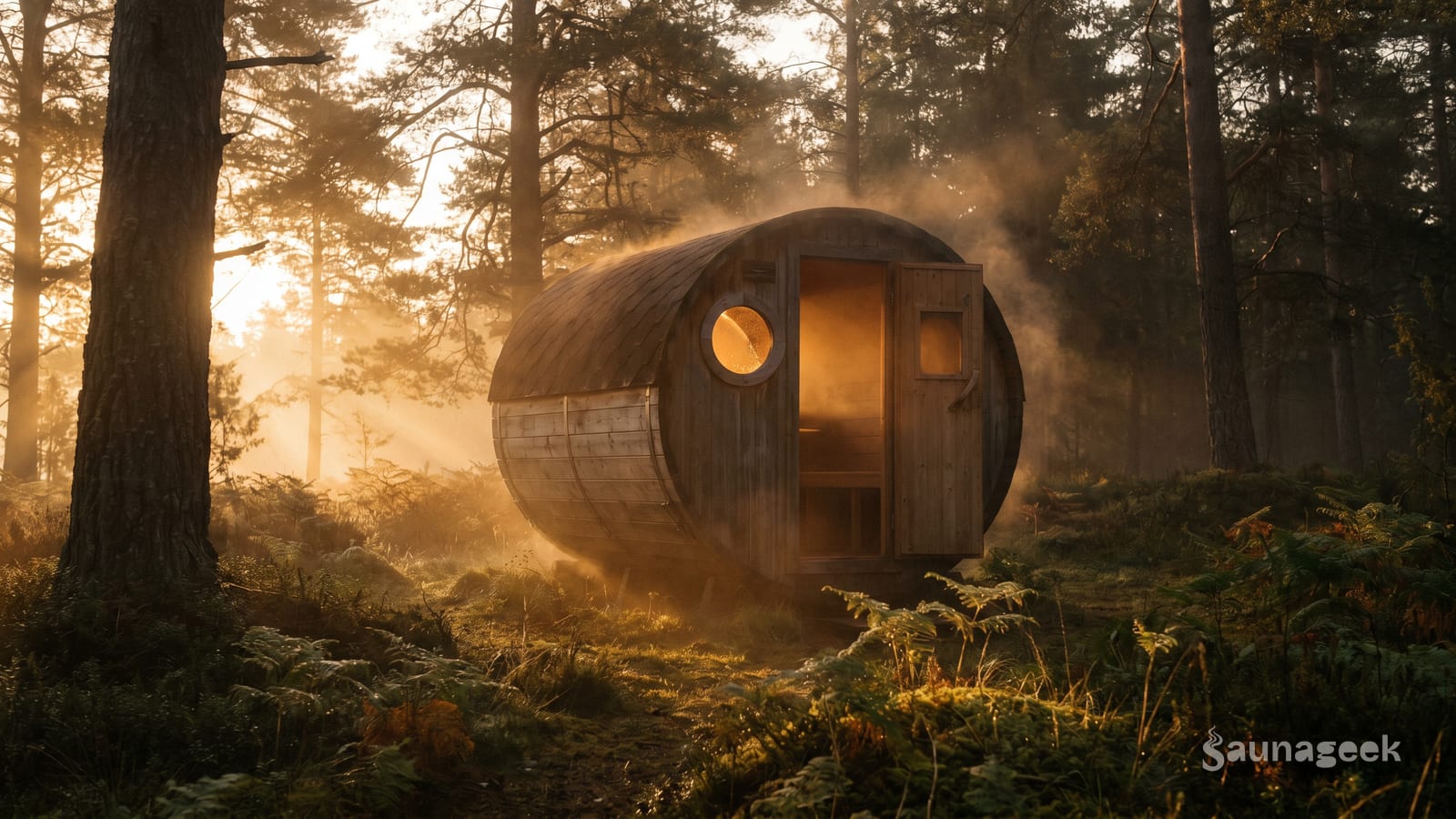
A barrel sauna is a cylindrical sauna built from horizontal wooden staves held together by stainless steel bands, giving it the look of a giant wooden barrel cut in half. The shape isn’t decorative. It actually works better than a square cabin sauna in several measurable ways. If you’re evaluating outdoor sauna options, here’s what barrel saunas do well, where they fall short, and how to decide if one belongs in your backyard.
What Is a Barrel Sauna?
A barrel sauna is an outdoor sauna shaped like a barrel. It sounds obvious, but the geometry matters more than most buyers realize.
The structure uses stave construction: long, curved wooden planks stacked horizontally and cinched tight with stainless steel bands. The staves interlock at the top and bottom via tongue-and-groove joints. When the wood absorbs moisture and expands, the joints seal tighter, not looser. That’s the opposite of how most wooden furniture behaves.
This construction method has been used for wine barrels and water tanks for centuries. The form has proven itself in conditions far harsher than a backyard.
Compare this to a traditional cabin sauna, which uses vertical paneling inside a square box. The barrel shape creates the usable sauna space without interior framing. Fewer materials, fewer places for things to go wrong.
Why the Round Shape Actually Matters
The round cross-section gives barrel saunas real performance advantages over square cabins.
Heat-up time. A barrel sauna heats roughly 30% faster than a comparably sized square sauna. The reason is volume. A square room has corners full of air that never gets fully circulated. Hot air pools in the ceiling corners while colder pockets sit near the floor. The curved walls eliminate dead corners. All the air in a barrel sauna participates in the convection loop.
Natural convection. Hot air rises along the curved ceiling and spills down the walls in a continuous cycle. You get even heat without a fan. In a square sauna, you often need ventilation engineering to avoid hot and cold stratification.
Ergonomic benches. Here’s one nobody talks about enough. The curved walls of a barrel sauna naturally support your back at multiple angles. As you lean back, the arc of the wall follows your spine. This isn’t a gimmick. It’s basic geometry. Square saunas require bench backrests to approximate what the barrel shape gives you for free.
Cold corners. Square saunas accumulate cold zones in corners and along walls far from the heater. Barrel saunas don’t have corners. Every point on the wall is equidistant from the heater. You feel the heat uniformly.
Barrel Sauna Sizes and What to Expect
Barrel saunas come in two diameter classes, which determines ceiling height and who can stand upright inside.
| Size | Diameter | Length | Capacity | Notes |
|---|---|---|---|---|
| Small | 1.5–1.8 m | 1.5–2 m | 2–3 people | Best for couples; limited standing headroom |
| Medium | 2–2.1 m | 2–3 m | 4–5 people | Good balance of space and heat efficiency |
| Large | 2.3–2.5 m | 3–4 m | 6–8 people | Full standing height in center; more material cost |
The diameter is the critical dimension for headroom. At 1.8 m diameter, the curved ceiling gives you standing room only in the center. About 1.7 m of headroom at the peak. If you’re over 180 cm tall, you’ll stoop unless the sauna is positioned so the widest section aligns with where you sit.
Length determines bench length and how many people can sit side by side. A 2-person barrel sauna typically has one bench level; a 4+ person unit usually has two bench levels.
Wood Types - What to Look For
Western Red Cedar is the standard recommendation for outdoor barrel saunas, and for good reason. Cedar contains natural oils that resist moisture, decay, and insect damage. It holds up outdoors without chemical treatment. It also has low thermal mass. It doesn’t absorb and hold heat the way denser woods do, so more of the heater’s output goes into warming the air.
Cedar is lighter than spruce or hemlock, which makes the barrel easier to position during installation.
Spruce is the budget option. It’s structurally sound and takes heat well, but it lacks cedar’s natural decay resistance. A spruce barrel sauna will need more maintenance and won’t last as long outdoors. Expect 10 to 15 years versus 20+ for cedar.
Hemlock is a mistake for outdoor use. It’s dense enough that it absorbs heat unevenly, and it lacks the natural oils that protect cedar. Over time, hemlock outdoor furniture cracks and splits. A barrel sauna made from hemlock will give you problems within a few seasons.
Kiln-dried staves matter regardless of wood species. Kiln drying reduces the wood’s moisture content to the level it will reach in service. Green (undried) wood will shrink after installation, opening joints and compromising the barrel’s structural integrity. Any reputable manufacturer kiln-dries their staves. If a supplier can’t confirm this, walk away.
Electric, Wood, or Gas - Choosing a Heater
The barrel shape affects heater behavior. Without corners to trap heat, a heater’s output circulates more efficiently. You can often run a slightly smaller wattage heater in a barrel than in a comparably sized square room.
Electric heaters are the most common choice. They install like a household appliance, run on 240V, and require no ventilation beyond standard sauna practice. Sizing: allow roughly 1 kW per 2.5 cubic meters of sauna volume. A 6 cubic meter barrel sauna needs a 2 to 2.5 kW heater. Oversize slightly if you’re in a cold climate.
Wood-burning heaters appeal to traditionalists who want the experience of a real Finnish sauna. Wood heat feels different. Radiant warmth rather than purely convective. The trade-off is installation complexity: you need a proper chimney, heat shields, and clearance from combustible materials. Wood heaters also take longer to heat the sauna.
Gas heaters are a practical option where electrical access is limited. They heat quickly and are relatively simple to install. Propane or natural gas both work. The flame behavior is different from wood, and some users notice a slight difference in humidity control, but gas is a legitimate choice for off-grid situations.
One note on heater placement: the barrel’s curved walls mean you can’t push a heater into a corner. Position it against the straightest section of the wall. Usually the section where the bench sits. This gives the best heat distribution.
How to Set Up a Barrel Sauna
Placement. Level ground is the baseline, but drainage matters more than most guides acknowledge. Water will splash out every time someone exits, and in rainy climates, runoff from the surrounding area will naturally collect under the sauna. Position it on a slight slope or raised surface so water drains away, not underneath. Gravel under the sauna base works well for drainage.
Distance from your house is a personal preference, but consider proximity to a changing area. Running to the house in a towel after a sauna session gets old fast. Some barrel sauna owners add a porch or covered area for changing.
Foundation. The options:
- Concrete slab: Permanent, level, excellent drainage if sloped slightly. Best for cold climates where frost heave is a concern.
- Gravel bed with paver stones: Simpler to install, drains well, can be relocated. Fine for mild climates.
- Timber frame deck: Works if the deck is properly engineered for the weight. A filled barrel sauna weighs 500 to 800 kg depending on size.
Assembly. Pre-built kits arrive as staves and bands with pre-drilled holes. You slot the staves together, thread the stainless bands through the pre-fitted brackets, and tighten. It takes two people roughly half a day for a medium-sized unit.
The door and windows come pre-hung in most kits. The heater installation (electrical in most cases) should be done by a licensed electrician. This isn’t a weekend project for someone unfamiliar with 240V sauna wiring.
Do not attempt to assemble a barrel sauna alone. The staves are awkward and heavy. You’ll also want someone to hold things level while you secure the bands.
Barrel Sauna vs. Cabin Sauna - Which Is Right for You?
Barrel saunas and traditional cabin saunas each suit different situations. Here’s an honest comparison.
Barrel wins:
- Faster heat-up and more even heat distribution
- Better heat efficiency (smaller heater, lower operating cost)
- Compact footprint. Good for smaller properties
- Lower material waste in construction (no interior framing)
- Rustic aesthetic that many people prefer for garden settings
- Faster to assemble
Cabin sauna wins:
- Full standing height throughout the entire space (no stooping in the corners)
- Easier to customize. Add changing rooms, multiple bench levels, interior partitions
- More interior space for larger gatherings
- Better long-term resale value for permanent installations
- Easier to extend or modify after installation
The honest answer: if your priority is efficient, enjoyable sauna sessions in a compact outdoor space, a barrel sauna is hard to beat. If you want maximum customization, full standing room, or a permanent structure integrated into a building, a cabin sauna is the better choice.
Real Maintenance - What to Actually Do
Barrel saunas are low-maintenance compared to many outdoor structures, but “low maintenance” is not the same as “no maintenance.” Here’s a practical schedule.
After each use:
- Leave the door cracked open for 30 to 60 minutes to dry out the interior
- Wipe down the benches with a dedicated sauna cloth or paper towel if someone sweated heavily
- Do not leave wet towels sitting inside
Annually (before the winter season):
- Check all stainless steel bands for tension. They stretch over time and need periodic tightening. Most kits include a tensioner tool.
- Inspect the wood for splitting, particularly near the top where UV exposure is highest
- Clean heater rocks. Remove any crumbled pieces and rearrange remaining rocks to allow proper airflow
- Check the door seal and hinges for wear
Every 2 to 4 years:
- Assess whether the wood needs a refresh coat of sauna-safe wood oil. Cedar usually doesn’t need it. The natural oils do the job. Spruce may benefit from it.
- Re-oil the door hinges if they’re hardware-store steel (stainless hardware doesn’t need this)
Cedar’s natural oils give it a real advantage here. You spend less time maintaining a cedar barrel sauna than a spruce one. The tradeoff is higher upfront cost.
What Do Barrel Saunas Cost?
A pre-built barrel sauna kit runs $3,000 to $9,000 depending on size, wood, and heater quality.
| Tier | Price Range | What You Get |
|---|---|---|
| Entry | $3,000–$4,500 | Spruce exterior, basic electric heater, single bench level, acrylic window |
| Mid-range | $4,500–$6,500 | Cedar exterior, quality electric heater, two bench levels, tempered glass door |
| Premium | $6,500–$9,000+ | Cedar, wood-burning or premium electric heater, larger dimensions, stainless bands, extended porch option |
DIY kit materials (staves, bands, benches, heater) run $2,500 to $5,000, but you still need foundation work and electrical installation. Budget another $1,000 to $2,000 for those unless you do the labor yourself.
What separates a $3,500 barrel from an $8,000 one? Wood thickness (44 mm staves versus 38 mm), heater quality (basic resistive versus purpose-built sauna heater), window material (acrylic versus tempered glass), and band quality. The cheaper units work, but you’ll feel the difference in how long the wood lasts and how the heater performs in cold weather.
Operating cost. Running a 2.5 kW electric heater for one hour daily costs roughly $0.30 to $0.35 in electricity at typical US residential rates. Monthly operating cost for daily use: $27 to 30. Wood-burning costs nothing in electricity but requires you to source and split firewood.
Barrel Sauna FAQ
How long does a barrel sauna take to heat up? About 20 to 30 minutes for a properly sized unit. The barrel shape means you lose less heat to dead corners. A 6 cubic meter cedar barrel with a 2.5 kW heater typically reaches 70 to 80 degrees Celsius (160 to 175 F) in under 30 minutes.
Can you use a barrel sauna in winter? Yes, but climate matters. In temperatures below -15 C (5 F), some barrel saunas struggle without additional insulation. The walls lose heat faster than the heater can compensate. For cold climates, consider a model with thicker staves (50 mm+) or add a reflective insulation layer behind the benches. Most manufacturers offer cold-climate packages.
Do barrel saunas need a building permit? Usually no, provided the sauna is under 15 square meters of floor space and not permanently affixed to a foundation. Many jurisdictions treat freestanding barrel saunas as temporary structures. Check your local codes. Rules vary by municipality.
What is the lifespan of a barrel sauna? A cedar barrel sauna lasts 20+ years with basic maintenance. Spruce units typically last 10 to 15 years. The stainless steel bands should last the life of the structure. Wood replacement for individual staves is possible if one is damaged.
Are barrel saunas better than square saunas? For heat efficiency and compact outdoor use, yes. For full standing height and customization, no. Each form has a legitimate use case. The round shape genuinely outperforms the square for heat circulation. That’s physics, not marketing.
Can you build a barrel sauna yourself? Yes, with a kit. The stave-and-band system is designed for two-person assembly without specialized tools. You need basic carpentry confidence, a second pair of hands, and a level foundation. Electrical and chimney installation (for wood-burning models) should be handled by licensed tradespeople.
Do barrel saunas smell like a regular sauna? Yes, cedar barrel saunas have a mild cedar aroma when heated. It’s pleasant and natural. The smell diminishes over the first several uses as the wood oxidizes and stabilizes. Unlike some manufactured materials, cedar doesn’t off-gas anything unpleasant.